Built Through Clarity · Organizational health framework

Healthy organizations are intentionally built through clarity.

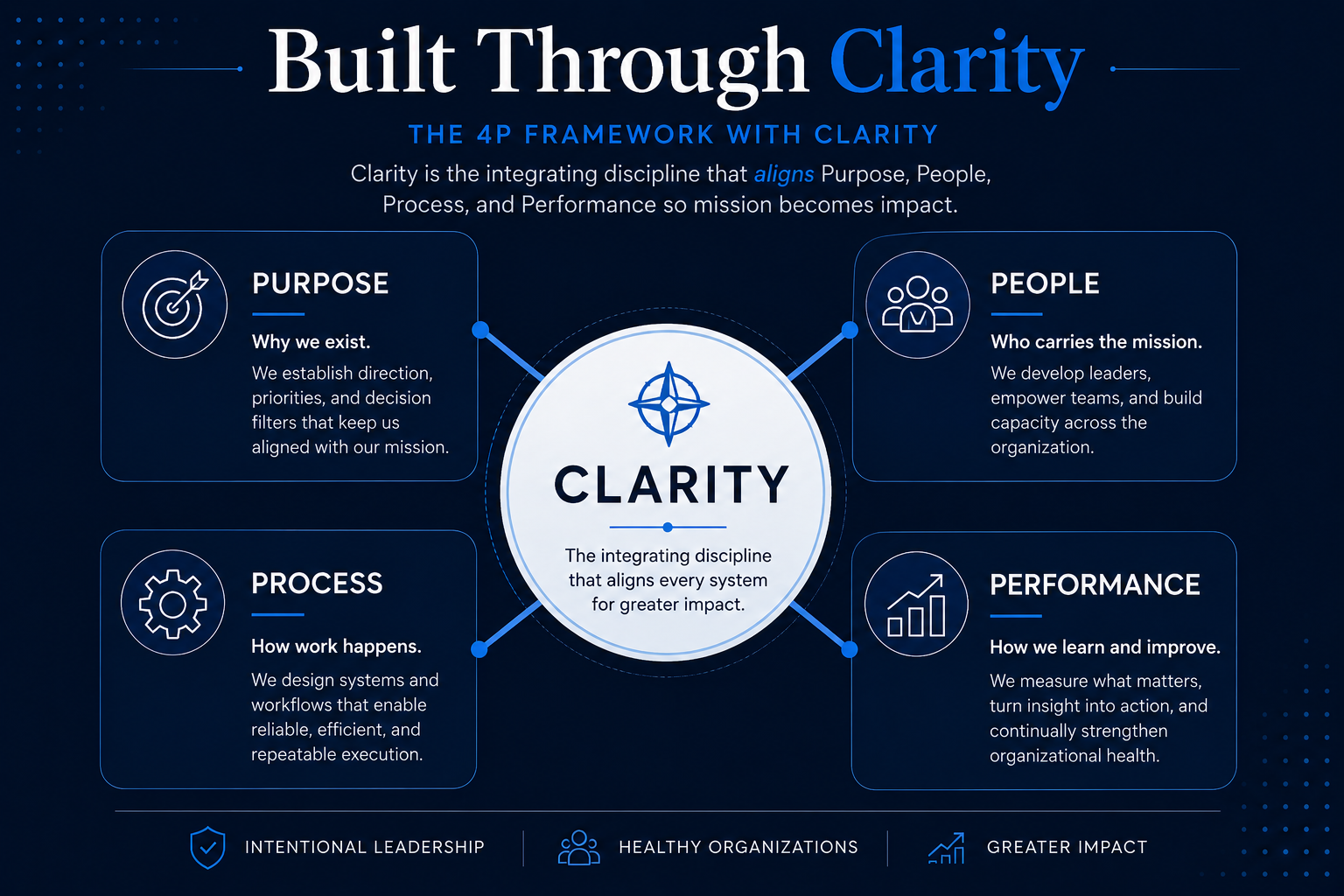
I think about organizational health through four interdependent operating systems: Purpose, People, Process, and Performance. Clarity keeps them aligned.

The framework grew from more than two decades of leading, coaching, building, and operating across corporate, entrepreneurial, and nonprofit environments. Different settings kept revealing the same organizational patterns.

I kept seeing good people struggle inside unclear systems.

Across corporate communications, sales leadership, operations, entrepreneurial work, and nonprofit leadership, I kept seeing the same problem. People cared and worked hard, yet bottlenecks, rework, burnout, inconsistent results, and dependence on a few key people persisted.

The symptom changed. It might look like communication, hiring, performance, process, or an overloaded leader. Underneath, the deeper issue was often alignment.

Purpose was not translated into priorities. People lacked context, authority, or development. Processes lived in memory or depended on heroics. Performance was measured without always creating learning. Leaders kept solving recurring problems because the system around the work had not been intentionally built.

That is why I organized my leadership thinking around Purpose, People, Process, and Performance. The missing piece was Clarity, the discipline that keeps the four systems aligned.

Organizations rarely become unhealthy because people stop caring. More often, confusion compounds until good people spend too much energy overcoming the system around the work.
Health is not the absence of pressure. It is the capacity to respond well.

A healthy organization knows why it exists, what matters now, who owns what, how work moves, how decisions are made, and how progress is understood. It can learn without sacrificing people or mission.

Organizational health is the sustained alignment of Purpose, People, Process, and Performance through Clarity, so the organization can fulfill its mission, develop its people, learn from reality, and grow without unhealthy dependence on one person.
A practical lens, not a claim that four boxes explain everything. Organizations are human systems shaped by relationships, culture, incentives, governance, resources, and history. The 4Ps provide a usable structure for seeing how those realities connect and where leadership attention may have the most leverage.

Four operating systems. One integrating discipline.

The four Ps are not departments or a checklist. They are interdependent systems. Strength in one can support the others; weakness in one can create friction across the organization.

Built Through Clarity framework showing Purpose, People, Process, and Performance integrated through Clarity.
01 · Purpose

Purpose establishes direction.

Primary question: Why do we exist, and what matters most now?

Purpose turns mission into choices. It defines priorities, boundaries, tradeoffs, and decision criteria when good options compete for limited resources.

Healthy evidence
People can explain the mission, current priorities, and why some work matters more than other work.
When it weakens
Priorities multiply, opportunity drives strategy, resources scatter, and mission drift becomes easier.
02 · People

People carry the mission.

Primary question: Who carries the mission, and how are they continually developed?

People create organizational capability. Healthy leadership gives them context, clear roles, decision authority, coaching, accountability, and room to grow in judgment.

Healthy evidence
People understand what they own, make decisions at the right level, coach others, and solve problems without unnecessary escalation.
When it weakens
Roles blur, approval chains grow, leaders rescue too often, development stalls, and the organization depends on a few individuals.
03 · Process

Process makes good work repeatable.

Primary question: How does good work happen consistently?

Process turns capable people into reliable execution through usable workflows, handoffs, governance, communication, documentation, decision paths, and operating rhythms.

Healthy evidence
Critical work is understandable, repeatable, adaptable, and able to continue during growth, vacation, turnover, or pressure.
When it weakens
Rework increases, tribal knowledge grows, handoffs break, meetings multiply, and recurring exceptions become normal.
04 · Performance

Performance creates learning.

Primary question: How do we know whether we are progressing and learning?

Performance is the learning engine. It connects outcomes, behaviors, evidence, coaching, and review rhythms so measurement leads to better decisions instead of fear or theater.

Healthy evidence
People understand why measures exist, review evidence regularly, coach behaviors, and use results to improve decisions and systems.
When it weakens
Activity replaces outcomes, metrics become punitive, dashboards grow without decisions, and the organization repeats preventable mistakes.
The integrating discipline

Clarity keeps the whole system aligned.

Clarity is not a fifth operating system. It is the disciplined work of making reality, priorities, ownership, boundaries, expectations, and learning understandable enough to guide confident action. It makes purpose usable, people capable, processes understandable, and performance meaningful.

Reality Priorities Ownership Decision rights Boundaries Expectations Communication Learning

One system, not five separate initiatives.

The value is in the relationships. Each system creates something the next needs. Performance sends learning back into Purpose, while Clarity keeps the connections aligned as reality changes.

Purpose Creates direction and priorities
People Turn direction into judgment and action
Process Turns action into reliable execution
Performance Turns execution into evidence and learning
Clarity continuously aligns the interfaces between every system.
Learning returns to Purpose so priorities, decisions, and the operating system can improve.
A common breakdown

Strong purpose without operating clarity.

A team can care deeply about the mission and still face competing priorities, unclear roles, slow decisions, and inconsistent execution. Commitment can mask weak systems until the cost appears in burnout, friction, or lost trust.

A healthier pattern

Mission translated into capability.

Clear purpose focuses decisions. Developed people carry responsibility. Practical processes reduce friction. Performance creates learning. Clarity keeps the system connected so growth builds capacity, not just activity.

It gives leaders a practical way to diagnose before they react.

Leaders experience symptoms first. The framework helps separate visible pain from the system producing it, then points toward the next responsible leadership move.

01

Turn mission into priorities.

Turn broad aspiration into choices, boundaries, resource decisions, and daily judgment.

02

Build capacity beyond the leader.

Develop people, distribute decision rights, and reduce dependence on one person.

03

Reduce organizational friction.

Find where unclear handoffs, approvals, workarounds, or information gaps consume energy.

04

Build systems without bureaucracy.

Standardize what must be reliable while preserving judgment where context matters.

05

Make accountability fairer.

Clarify outcomes, ownership, authority, support, and expectations before judging results.

06

Scale without losing the mission.

Grow capability so more impact does not require more heroics from the same people.

If everything feels urgent... Start with Purpose. Are priorities and tradeoffs actually clear?
If decisions keep coming back to one leader... Start with People and Clarity. Are authority, capability, and decision rights truly distributed?
If good people keep reinventing the work... Start with Process. Is critical knowledge usable, owned, and repeatable?
If the dashboard is full but learning is thin... Start with Performance. Are measures changing behavior, decisions, or systems?
If teams hear different versions of the same priority... Start with Clarity. Where is meaning becoming diluted, distorted, or assumed?

Leadership is stewardship. The goal is stronger people and a stronger organization.

The framework is not only about efficiency. It reflects convictions about how authority, people, systems, and performance should work together.

Clarity is an act of care. People should not have to decode what matters, who owns what, or what good looks like.
Accountability starts with clarity. Fair accountability requires expectations that are clear, stable, and supported.
People are not merely resources to deploy. Healthy organizations equip people to grow, exercise judgment, and carry increasing responsibility.
Systems should serve people and mission. Structure should make good work clearer, safer, more reliable, or more scalable.
Metrics should create learning, not fear. Performance information should illuminate reality and improve decisions, behaviors, and systems.
Great leaders build capacity beyond themselves. The goal is not indispensability. It is stronger people, systems, and mission.

When something feels off, ask better system questions.

The framework becomes useful when it changes the questions asked before adding another meeting, rule, metric, hire, or emergency fix.

Purpose

Are we solving the right problem?

What is true now? What matters most? What are we choosing not to do? What decision should our mission make easier?

People

Can the people carrying the work succeed?

Do they have the context, capability, authority, support, and coaching required to own the outcome?

Process

Can good work happen reliably?

Where are handoffs breaking? What depends on memory or personality? Which recurring exception is telling us the system needs redesign?

Performance

What is the evidence teaching us?

Are we measuring what matters? Which behaviors drive the result? What decision or experiment should follow from what we learned?

Clarity

What is still ambiguous?

What are people interpreting differently? Which priority, owner, boundary, decision, expectation, or assumption needs to become explicit enough for people to move with confidence?

Practitioner-built. Designed to be tested and strengthened.

Built Through Clarity is my synthesis of operating experience, recurring organizational patterns, leadership principles, and practical tools. It is designed to be memorable enough to use and substantial enough to guide real decisions.

I am building the work as a living system. The framework informs the Healthy Organization Scorecard, diagnostic tools, leadership principles, future writing, and a broader organizational health methodology.

No model explains every organization or leadership problem. Context and evidence matter. This framework should become more precise as it is tested against research, real organizations, leader feedback, and results.

The standard: useful enough to change behavior, grounded enough to earn trust, and clear enough to use without dependence on an expert.

A practical place to start

See where your organization is strong and where friction may be hiding.

The Healthy Organization Scorecard examines Purpose, People, Process, and Performance, with Clarity as the integrating discipline. It shows where the system appears strong and where leadership attention may be most useful.

Take the Health Scorecard